It's not knowing what every line of code does.
It's being able to answer why.
Why was this built this way?
Why did we choose this architecture?
Why was this decision made?
What alternatives did we consider?
What assumptions did we make?
And when something inevitably breaks, can we trace those decisions backwards, understand the reasoning, and figure out what went wrong?
That is understanding.
For most of software engineering, understanding was created naturally through execution. You investigated the problem, read the code, thought through the approach, made decisions, implemented it, broke things, debugged them, and eventually shipped.
You understood the system because you participated in building it.
§ 01AI coding agents are beginning to break that relationship.
Agents increasingly explore the codebase, decide how to approach a problem, write the implementation, debug it, refactor it, and ship the result.
The output might be completely correct.
But the execution happened without all of the understanding necessarily passing through the team.
And as more execution and decision-making moves to agents, the gap grows.
AI is making execution faster than teams can build understanding.
§ 02This eventually becomes a speed problem.
When you understand a system, you can change it confidently. You know what a change affects. You can debug failures by tracing decisions backwards. You understand why certain constraints exist. You can recognize when an old assumption is no longer true.
Without that understanding, every change requires rediscovery.
Addy Osmani calls one part of this comprehension debt, the growing gap between how much code exists and how much of it humans genuinely understand.
But I think the problem goes beyond understanding code.
A software team needs to understand the reasoning behind the system.
What changed.
Why it changed.
What decisions were made.
What assumptions were introduced.
How one person's work affects another's.
And increasingly, what decisions their agents are making on their behalf.
§ 03The bottleneck moves.
AI can generate more code.
More PRs can get merged.
More tasks can get completed.
But if the team's understanding doesn't increase at the same rate, eventually the bottleneck simply moves from execution to understanding.
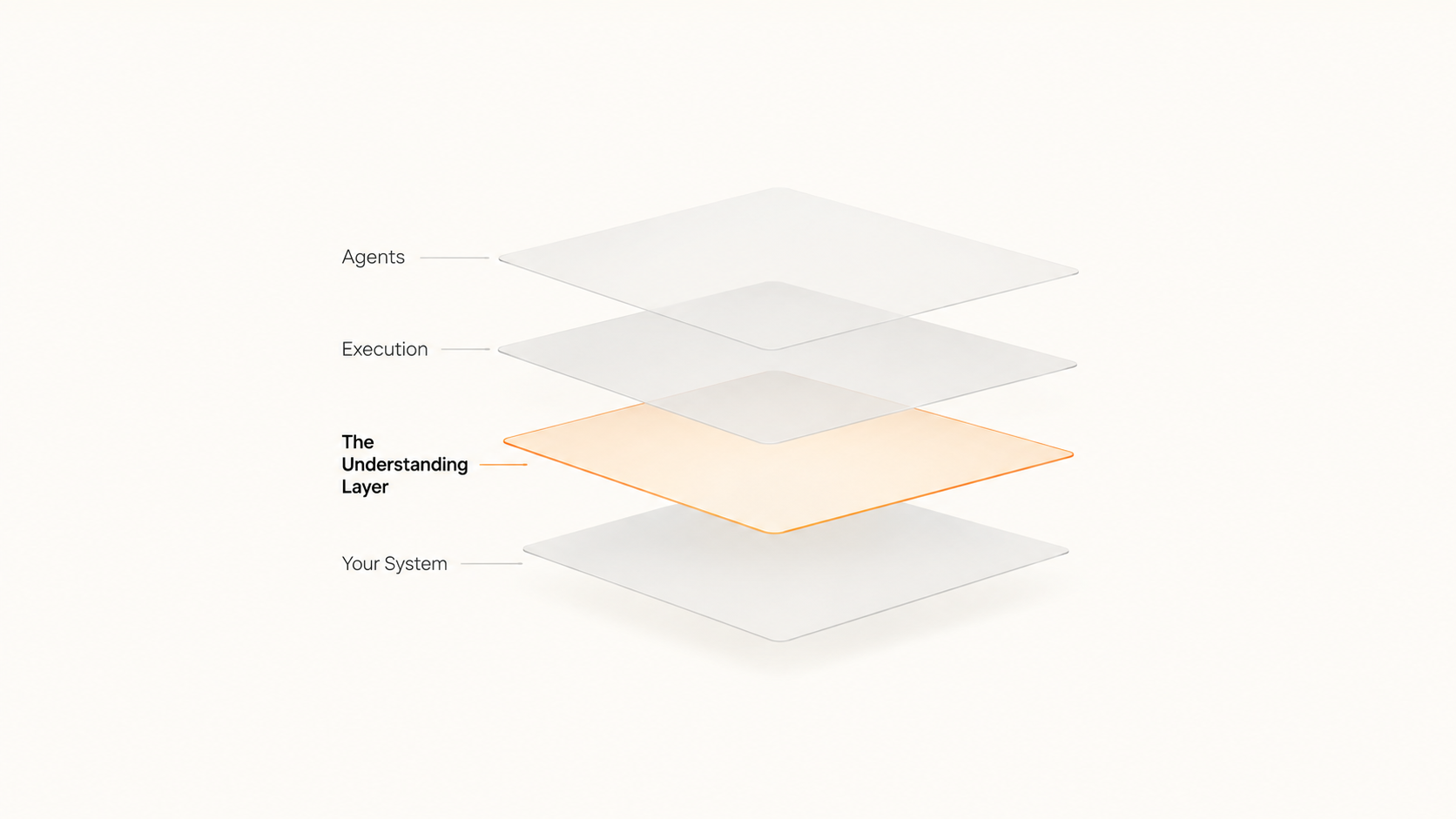
§ 04AI-native engineering teams need a new layer.
The understanding layer.
A layer that continuously builds an understanding of the work happening across engineers and their agents: the decisions, reasoning, changes, context, and relationships between them. It gives that understanding back to the team when they need it.
Not more documentation for engineers to maintain.
Not more dashboards showing activity.
Understanding.
So when an engineer or their agent needs to know why something is the way it is, the organization can answer.
That's what we're building with Meridian.
The understanding layer for engineering teams: keeping everyone and their agents on the same page.